
 Junio
The tennis balls keep landing in the neighbour’s roses. The children are tired of fetching them, the neighbour is tired of apologies, and the club committee has just received a complaint about balls bouncing onto the car park. A court without a proper perimeter turns into a nuisance surprisingly quickly, whether it sits behind a house or beside a pavilion.
Start with the Space You Actually Have
A standard doubles court measures roughly 23.77 metres by 10.97 metres between its lines, but the playing area is only part of the story. Players need generous run-off behind the baselines and along the sides, so the space inside the fence should be noticeably larger than the court itself. Measure the whole plot, check the slope of the ground and note the position of trees, drains and boundaries before you commit to a layout. A court squeezed into too small a footprint feels cramped to play on, however good the surface.
Height, Mesh and Posts
Perimeter height is the first decision. Many courts use a fence of around three metres, with extra height behind the baselines where lobs and wayward serves fly furthest. Taller sections stop more balls but cast more shadow and catch more wind, so the right figure depends on the site. Mesh matters as well. A tighter weave keeps small balls from slipping through, and a plastic-coated finish resists corrosion and looks neater than bare metal. Posts need sturdy foundations because a long run of mesh behaves like a sail in a gale. If the court sits on a hillside or exposed field, ask whether the posts should be closer together or set deeper than usual.
Choosing Between Materials
Galvanised steel with a coating is the usual choice for lasting performance, and it copes with damp British winters far better than untreated metal. Colour is more than decoration. Dark green or black mesh recedes visually, helps players track the ball against the background and blends into gardens. Gates deserve thought too. Put one where it suits maintenance and equipment as well as people, and make sure it is wide enough for a roller or a mower to pass through.
Why Specialist Tennis Court Fencing Is Different
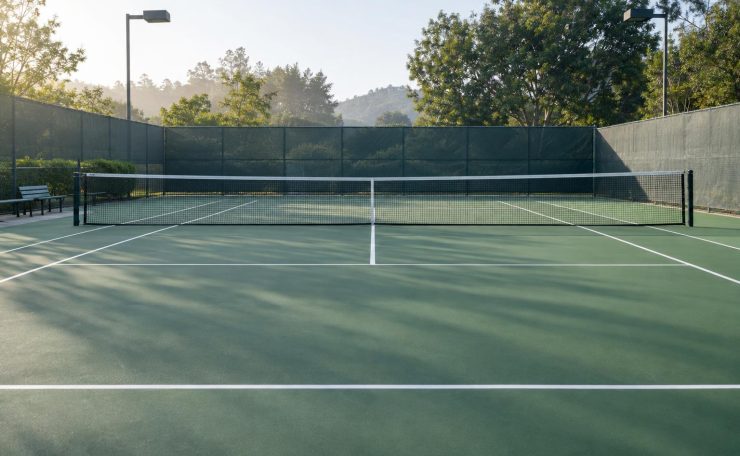
It is tempting to treat the perimeter as an ordinary garden boundary, yet purpose-built tennis court fencing has to cope with repeated ball impact, constant wind loading and the need to keep a clear, tidy line around the playing area. Rebound noise is another factor, since a loose panel rattles with every hit and irritates neighbours. Corners need particular care, because that is where balls strike hardest and where cheap installations tend to sag first. Ask any installer how they tension the mesh and secure it at the corners, and whether the quote covers ground preparation, because a fence is only as steady as the soil underneath it.
Permissions, Maintenance and Neighbours
Fences above a certain height, and floodlights, may need planning permission, so talk to your local planning authority early instead of discovering the rules after the concrete has set. Think about lighting too, as glare spilling onto neighbouring windows causes more disputes than the sound of a ball. Courts used by a club face heavier wear than a family one, so build in extra durability at the gates and along the sides closest to the clubhouse. Once the court is built, hose down the mesh each season, keep leaves and moss from piling against the base, and check the fixings after storms.
A well-planned perimeter does quiet work. It keeps the balls in, the neighbours happy and the court looking good, so the only thing left to argue about is the score.